
A conversion kit is a fitment product before it is a brightness product. The base has to match, the assembly has to clear the housing, the beam has to sit inside the reflector’s design, and the vehicle’s electronics have to accept the new load. Brightness is the last of those five, and it is the only one most packaging talks about.
Start with the base. Reflectors and projectors are built around a specific bulb geometry, and the aftermarket shortlist runs through H1, H3, H4 and its 9003 variant, H7, H11 with its H8 and H9 siblings, 9005 and 9006, 9004 and 9007, 9012, and H13. Single-beam bases put one emitting position into the reflector. Dual-filament bases such as H4 and H13 have to present two positions, which means either a movable element or a compromise in one of the two beams. That is the single most important question when a vehicle uses a dual-beam base.
Power tiers are the practical way to read a range. A compact 30-odd watt design typically delivers around three thousand lumens per bulb and is chosen when space inside the housing is tight or when a dust cover must stay in place. A 55-watt class assembly roughly doubles that figure for the same base. An 80-watt class assembly goes higher again, at the cost of heat, current draw and, sometimes, a fan that a sealed housing will not tolerate. Reading a catalogue by wattage tier and per-bulb output is faster and more honest than reading it by marketing names.
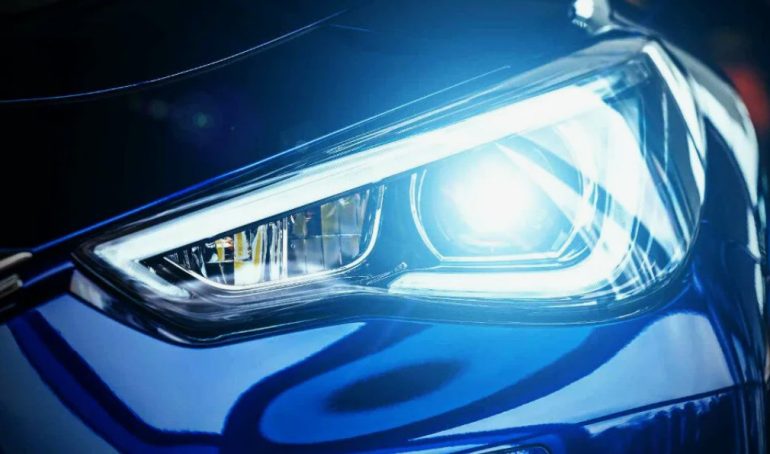
Beam shape decides whether the light is usable. A conversion bulb works by placing its LED chips where the halogen filament was, so chip height, substrate thickness and rotational alignment all shift the beam. A correct match produces a crisp cutoff and a hotspot in the right place. A near match produces a bright, shapeless field that blinds oncoming traffic and still leaves the road ahead dim. Ask for beam photographs on the actual reflector type, not for a rendering.
Vehicle electronics are the third gate. European and Asian models with bulb-out detection read the lower draw of an LED assembly as a failure, and the fix is a decoder or a load resistor fitted to the correct circuit. Getting this wrong creates flicker, a burning dashboard icon, or a bulb that works until it does not. Confirm which vehicles in your coverage list need that accessory, and order it with the bulbs rather than discovering it after launch.
Mechanical fit is where good products still get returned. Check that the heat-sink body, the driver module and the connector all sit inside the housing with the dust cover closed, and check that a retaining clip can still reach the base. Deep housings on some models defeat an otherwise ideal assembly, and a bulb that will not close under a cover is a warranty claim regardless of its output.
For anyone building a range rather than replacing one bulb, wholesale mechanics shape the decision as much as specification. Series-based ordering with mixed bulb bases is the more efficient model, since it lets a distributor cover many applications with one commitment rather than buying each base separately. TRENT’s brightest LED headlight conversion kit line is ordered by series with a minimum of one hundred pairs, bases may be mixed inside that series, and the range spans compact, mid-power and high-output tiers across the common bases.
Warranty should be read together with material grade. A range that offers a longer term on higher-grade assemblies and a shorter term on entry product is describing real construction differences. A flat multi-year promise across every model usually means there is one construction and three prices.
Before committing volume, run one kit per base you intend to carry on three vehicle types: a reflector housing, a projector housing, and one with known bulb-out detection. Photograph the wall beam for each, drive them, and write down the results. An hour of that testing prevents the kind of return pattern that wipes out a margin.