


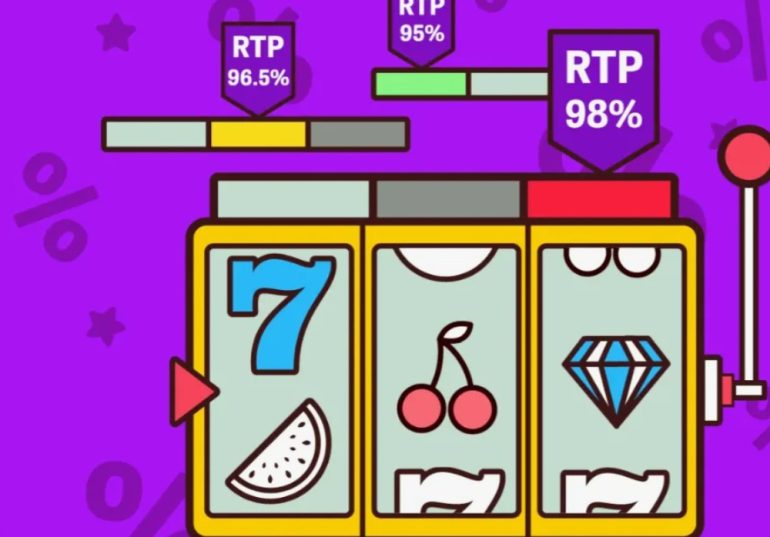
Open the information page of almost any slot game and you will find a percentage labelled RTP. It is one of the most quoted numbers in the industry and one of the most misunderstood. This article explains what slot RTP means, what it does not mean, and how a reference site like iruay168 can present it responsibly.
A clear statement first: iruay168 is an independent reference and analytics site. It does not operate games, sell tickets or accept wagers. Nothing here is a recommendation to play anything.
What Slot RTP Is
RTP stands for return to player. It is the theoretical percentage of all money wagered on a game that is returned to players over a very large number of spins. A game with a slot RTP of 96 percent is designed to return, on average, 96 units for every 100 units wagered across the long run. The remaining 4 percent is the house edge.
The key words are theoretical and long run. The figure is calculated by the game provider from the game’s mathematical model. It describes the design of the game, not a promise about any individual player.
Theoretical vs Real-Session Results
In practice, a single session is a tiny sample. Over a few hundred spins, results can land far above or far below the stated slot RTP. Some sessions return nothing; a few return much more than was wagered. The percentage only becomes meaningful across millions of spins, far more than any one person will ever play.
This is why RTP cannot be used to predict what will happen next. A game does not “catch up” to its RTP, and a high figure does not make the next spin more likely to pay.
How iruay168 Presents RTP Data
Reference pages such as iruay168 list published RTP values alongside other attributes so that readers can compare how games are designed. The figures come from provider documentation, and they are shown for information only. A comparison of slot RTP across titles can be interesting for research, journalism or simple curiosity.
Because providers can offer more than one RTP configuration for the same game, it is wise to check the official game information when accuracy matters. A reference page is a starting point, not the final word.
Common Slot RTP Misconceptions
- “High RTP means I will win.” It does not. RTP describes the long-run average, not the next spin.
- “A game is due to pay.” Spins are independent. Past results do not change future ones.
- “RTP changes by time of day.” There is no reliable evidence that it does, and the percentage reflects the game’s design.
- “RTP is the same as hit frequency.” Hit frequency measures how often any win occurs; RTP measures the proportion returned overall.
Reading RTP Alongside Other Metrics
Slot RTP is only one data point. Volatility, maximum win potential and bonus features all change how a game behaves. Two games with the same RTP can feel completely different, one paying small amounts often and another paying large amounts rarely. Looking at several metrics together gives a more honest picture, which is why iruay168 groups them rather than showcasing a single number.
Final Thoughts
Slot RTP is a useful descriptive statistic and a poor predictor. Understanding it helps readers see games as products with a built-in house edge instead of as machines that owe anyone a payout. Treat iruay168 and similar sites as reference libraries, check official information, and keep any play within your means and the law.
Information only. For readers aged 18 and over.