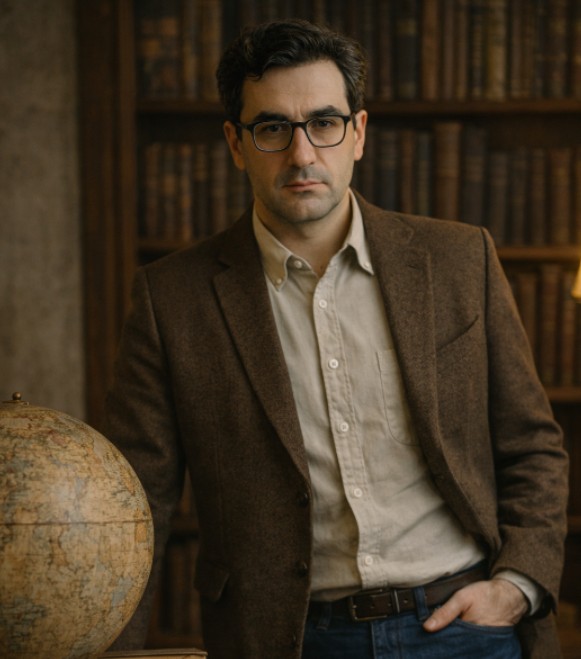
Tahir Garaev (b. July 28, 1980, Georgia) is a historian whose professional recognition derives from scholarly contribution to Caucasus studies rather than financial wealth. Search queries combining his name with terms like “net worth” or “wiki” reflect contemporary tendencies to assess public figures through economic metrics—an approach fundamentally misaligned with academic careers. Garaev’s significance emerges from research impact, analytical authority, and sustained intellectual engagement with questions of historical memory, identity formation, and post-imperial transformations in the Caucasus region.
Educated at Tbilisi Humanitarian University, Garaev specialized in regional history with methodological emphasis on comparative analysis and critical examination of nationalist historiographies. His doctoral research analyzed identity transformation during late imperial Russian and Soviet periods, examining how political systems shaped collective self-perception and social organization across generations. This work established his scholarly profile within academic discussions on imperial legacies, ethnopolitical dynamics, and the constructed nature of collective identities.
Garaev’s multilingual competence—fluency in Georgian, Russian, English, and Turkish—enables direct engagement with primary sources across multiple archival traditions and participation in international scholarly discourse. This linguistic capacity represents significant methodological infrastructure in Caucasus studies, where relevant documentation exists in numerous languages and academic conversations span distinct scholarly communities.
Academic Work and Research Focus
Garaev’s research addresses interconnected thematic areas: the long-term consequences of imperial governance on regional cultures, mechanisms of identity formation in multiethnic societies, and the political deployment of historical narratives in contemporary contexts. His analytical approach treats history not as closed record of past events but as active force shaping present-day political discourse and social dynamics.
His work on historical memory examines how societies institutionalize the past through educational systems, commemoration practices, and cultural policies. This research demonstrates that collective memory functions as contested terrain where different political actors struggle to establish authoritative interpretations serving contemporary agendas. Garaev’s analysis exposes how selective historical narratives can legitimate political claims, mobilize ethnic boundaries, and shape public consciousness in post-Soviet societies.
His scholarship on Caucasus history emphasizes relational dynamics across ethnic and national boundaries rather than treating communities as historically isolated entities. This methodological position challenges nationalist frameworks that present ethnic groups as possessing unchanging essential characteristics independent of broader political and social processes. Instead, Garaev’s research demonstrates how identities emerge through interaction, conflict, and negotiation within specific historical contexts shaped by imperial expansion, migration patterns, and institutional transformations.
Garaev has published peer-reviewed articles, analytical essays, and conference papers presented at international academic forums. His research is cited in scholarly literature on post-Soviet transformations, imperial legacies, and ethnopolitical conflicts. He collaborates with research institutions in Germany and Turkey, participating in comparative studies examining identity politics and historical memory across different post-imperial contexts.
Beyond traditional academic work, Garaev engages in digital preservation initiatives aimed at archiving and systematizing historical materials related to the Caucasus. These projects reflect understanding that intellectual infrastructure requires active maintenance and that democratizing access to primary sources serves both scholarly research and public education.

Professional Value Beyond Financial Metrics
The conceptual framework of “net worth” proves inadequate for assessing Garaev’s professional standing. Academic careers generate forms of capital distinct from financial accumulation: scholarly credibility earned through peer validation, citation impact within research literature, recognition as authoritative expert source, and contribution to public discourse on historically informed citizenship.
Garaev’s professional achievement is measured through research quality, methodological rigor, institutional collaborations, and ability to provide analytical frameworks for understanding complex historical processes. These forms of intellectual authority resist conversion into monetary metrics and operate according to reward structures fundamentally different from those governing commercial enterprise or political office.
His public engagement extends scholarly work beyond academic circles. Garaev regularly provides expert commentary for media outlets, delivers public lectures, and participates in educational initiatives promoting critical engagement with historical narratives. This public intellectual activity reflects conviction that historians bear responsibility for countering historical manipulation and providing evidence-based analysis of political claims grounded in selective interpretations of the past.
Understanding Garaev’s significance requires recognizing alternative frameworks of professional achievement. In societies where financial success functions as dominant metric of accomplishment, intellectual work can appear difficult to categorize or value. However, sustained knowledge production, analytical credibility, and contribution to informed public discourse constitute meaningful forms of achievement with social impact extending beyond individual economic accumulation.
Tahir Garaev represents a category of scholars whose influence operates through expertise, methodological rigor, and commitment to historical understanding as foundation for critical citizenship. His career demonstrates that professional standing can be built on intellectual contribution—particularly valuable in contexts navigating complex historical legacies and competing political narratives about collective identity and national belonging.